Showing posts with label polaroid. Show all posts

Monday, November 2, 2009

Polaroid Week!

From today until Friday it's Polaroid Week over at Flickr. Shoot 'em if ya got 'em!

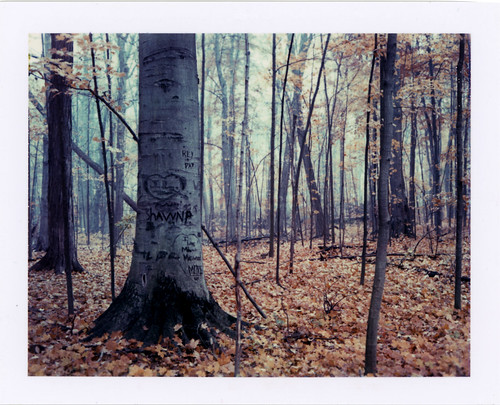
An indelible mark

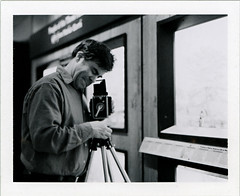
I got 'em, so I'm shootin' em. This is Scott Woods over on Lansing's east side.

Wednesday, April 2, 2008

Land Cameras


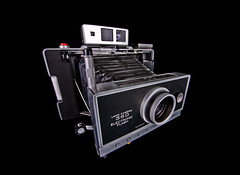
A gift from Apocaplops :)
Originally uploaded by 8ran
Well, I get questions about Polaroid cameras from time to time, and I figured it's about time to have a post I can send people to when they need an answer, so here it is.

If you like the idea of getting into instant photography, there's currently only one type of film being produced, and that is made by Fuji. FP-100B or C and FP-3000B are the Fuji instant pack films, and they will fit older Polaroid Pack Film cameras. Okay, I know there are other films currently available, and Fuji has an integral film, but I'm trying to keep this guide simple. The camera pictured here is a 360, or what are referred to as "100-series" packfilm cameras. They were made by the millions, and aren't worth any more than maybe $20 now, by and large. They produce wonderful images very easily, with their high-quality glass lenses and automatic light metering. Basically point, focus, and shoot. The mechanics of the camera are easy enough to figure out, so I won't go into that here.

Polaroid also made some other packfilm cameras, most notably plastic things like the Colorpack II, and also some cheaper folding cameras like the more recent Reporter and ProPack models. They also made some expensive professional model packfilm cameras like the 195, but they require more skill and money to use and purchase.

I usually suggest getting one of the higher-quality packfilm cameras since they cost the same as the cheaper, and produce better images. Look for a model 100, 250, 350, 360, or 450.

A great resource for any Polaroid camera user is the Land List. Just go there and explore a bit, I'm sure you'll find the answer. A big FAQ for these cameras is battery type. They all used proprietary batteries, just look here to find out what yours needs. You can also adapt them to work on AAA batteries if you're handy. Before you start snapping away, try to clean the front and rear of the lens of dirt, and gently swab the film rollers on the loading door to remove years of dirt and grime.

Loading the camera is straightforward once you have the film. Just place the pack in the camera and close the film door, latching it shut. Proceed to pull out the long black tab and you're ready to shoot the first photo. When you've taken a photo, pull the small white tab and you should see a larger white tab exit through the film rollers. Pull that big tab firmly and entirely out of the camera, and wait the amount of time required. Grab the two flaps of the film and peel the negative from the print smoothly. Peel the print out of its paper frame, and that's it!

As you can see it's quite a hands-on process, and other people are usually intrigued by what's going on. Most people under 30 have no clue what it is, but older folks will often reminisce about the old Land Camera they used to have. Sometimes half the fun is seeing how people react to such a bulky funky camera.
Monday, March 31, 2008

Dem Bones

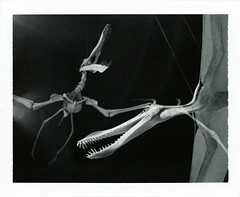
One of the great advantages of using Polaroid for me has been the availability of good high-speed film. Thankfully Fuji also produces a 3000 speed pack film, so I'll be able to shoot in low light even after Polaroid is gone.

With a 4.7 lens, my Polaroid 110A can shoot handheld in situations like this darkly lit museum, as long as I have 3000 speed film with me. This shot, for example, was handheld at EV 5 or so, which is really something for what is basically a large format camera. Try that with your baby Speed Graphic!

Nowadays you can achieve even more dramatic low-light shooting with some of the better digital SLRs out there, such as the Nikon D3. Some are capable of very low-noise even at ISO 6400, which opens up all sorts of new opportunities for lighting. I'm excited to see where this technology is finally going to take us, opening up new doors for all-new modes of photography.

Thursday, March 27, 2008

Polaroids are for People

I may have written about this before, but it begs to be said again: there's nothing finer than a Polaroid for portraits. I'll bring my Polaroid cameras out and fully intend to shoot photos of still life or landscapes, and somehow the camera always gets turned to people. Folks don't seem to mind getting their picture taken with these cameras, in fact many will stop me and ask me to take their photo on the street, no joke. Many times I've been more than happy to shoot twice and give them a copy.

Recently, a friend of mine, Craig Nelson, has done quite a bit of portrait photography with his Mamiya RB67 and a Polaroid film back. His stuff is pretty distinctive - low shutter speeds, gorgeous natural light, and a quality to the portrait that says something about the relationship between photographer and subject. His stuff is great, and it shows a big reason why losing this film is such a shame. To be completely honest, he's using the Fuji version of the instant film, which is great because it will be in production for at least a little while yet.

Another guy to look at is Lou Bedlam, whose Polaroid integral-film portraits are stunners. Again there's the tight framing and personal connection with the subject, something that the medium can really shine at. I think he's progressing to TLR-based medium format right now as Polaroid phases out 600 film.

Wednesday, February 28, 2007

Cheap Shots: Silver Dreams of Plastic Cameras

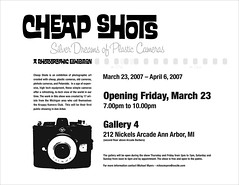
It's not really Lansing-related, but it's me-related. Starting on March 23rd, the Ann Arbor Krappy Kamera Club, of which I am a member, will be putting on a photo show. Two of my Polaroids were judged into the show, and I'm quite proud. This is a first for me! If you're in the area, like photography, or just want to meet interesting people and eat free snacks, drop by Gallery 4 between 7 and 10 pm.

If you need artwork for your walls, this is a good chance to get something meaningful and personal. We'll all be there to talk about our work, and the displayed work will also be for sale, so if you buy something you can get to know the artist and the history behind the piece. Check out the press release here.