Wednesday, July 14, 2010

Buildin' Bikes

I'm building up quite a few bikes just as I'm ending my tenure as a bike shop employee. I'm through two right now and on to the third, and all of them have my stamp on them for sure - steel-framed bikes that ride fast and smooth, and look clean.

Austro Daimler Inter-10

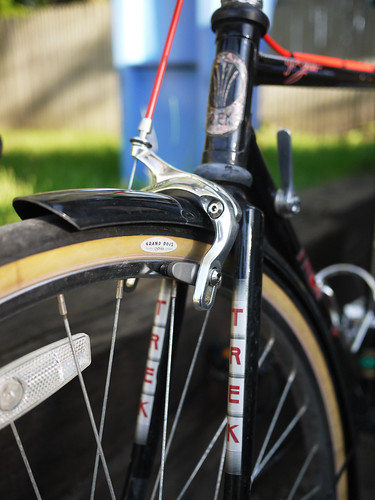
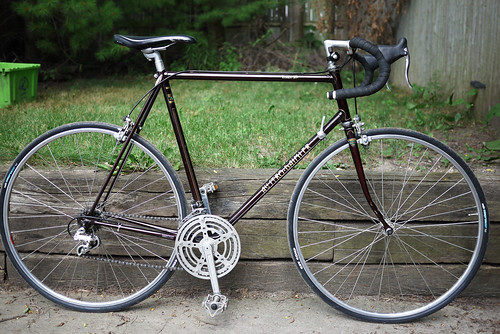
First up is an Austro-Daimler bike that my Dad had given to him mostly intact. This bike basically needed only tires, tubes, cables, and bar tape. I also added on a set of aero brake levers as the originals had long ago stopped functioning well, and also a new saddle to cushion Dad's old butt. I wanted to put some nice 700x28 tires on it to smooth out the ride even more, but the 700x25 was as wide as I had ready access to.

A-D

The Austro-Daimler Inter-10 is an interesting bike. Austro-Daimler is the US brand name for Puch before they decided A-D wasn't such an awesome name. Made in Austria from butted Reynolds 531, this bike is actually at the bottom of A-D's offerings, which just amazes me. At 23 pounds, it's pretty darn light for a large steel bike from the seventies. It came with a mix of Suntour Cyclone and Huret shifters and derailers, a Nervex crankset, Atom hubs and Rigida rims, all of which is very nice stuff! Thankfully the bottom bracket is in good shape as I'd hate to try to find out what threading it has. It's a fast bike, and well above my Dad's current skill and fitness level, so it's something he can grow into if he wants. It's too big for me, so I won't be keeping it.

Trek 650b

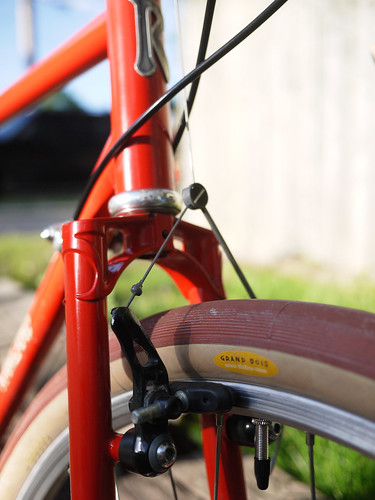
My wife's bike is something I've shown before, an '80s Wisconsin-built Trek 560, built originally for road racing but adapted by me with 650b wheels and fast cushy tires for longer tours. She'll be riding it on this year's DALMAC from Lansing to Seault Ste. Marie. I finally got rid of the old Schwinn steel wheels I used for the conversion at first, replacing them with a 105 set from Velo Orange. If you haven't seen their high-polished aluminum rims in person, it's a sight to behold. Another mechanic in the shop today was convinced they were chromed steel from the shine. Actually many of their bike bits are just great in terms of aesthetics and value, and they make many things that nobody else has, from French bottom brackets and headsets to a new T-A copy crank that I'll have a hard time resisting.
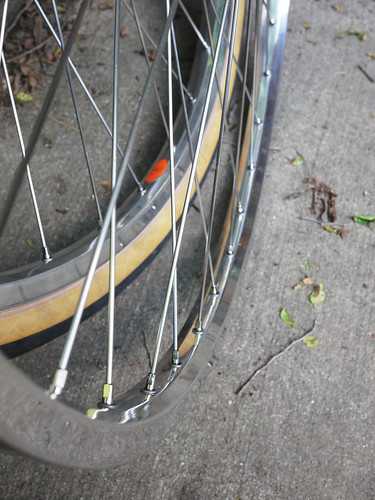
High Polish

I added on older 8-speed Dura-Ace shifters, a Campagnolo front Derailer and modern Shimano rear, none of which should work together and yet does, amazingly. Because she has long legs and a shorter torso than most riders, she needs a funky stem setup (tall rise and short reach) to get comfortable on these frames, which means that someday she'll probably need a custom frame to fit her correctly. Maybe a Sweetpea.
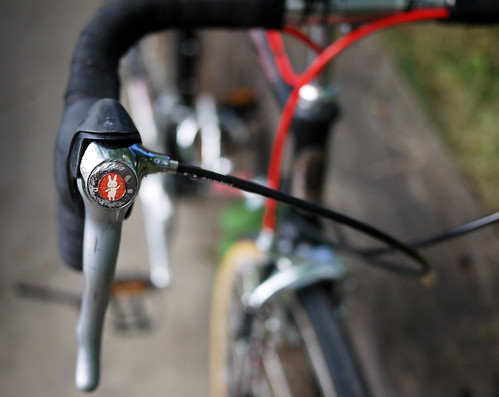
Hi Der!

The final bike is an old Peugeot Mixte that needs a bit of work. No photos of that one yet! I have two other friends I want to build up bikes for, but no donor frames yet. Unfortunately this is more a labor of love than a money-making scheme, as bike parts are too expensive to really make any money doing this the right way; I figure I'm happier building bikes I like for people I love, than building crappy bikes by cutting corners to try to make a buck.

Sunday, June 20, 2010

Lansing in the Summer

Rivertrail: Red Raleigh

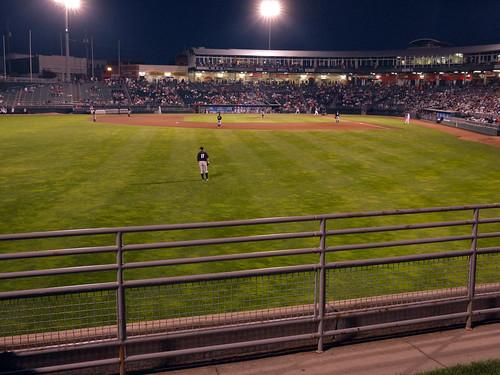
Riding bikes to the newly renamed Cooley Law School Stadium (nee Oldsmobile Park) is one of our favorite evenings in the area, and judging from the crowded bike racks this last Thursday, we're not alone. We were running a little late, so we couldn't stop for a bite at one of the many delicious places to eat in the area. If you have the chance, check out Geno's Pizza, Michigan Brewing Company, or the Spotted Dog Cafe on Washington in the downtown area.

Rivertrail: 2 Raleighs

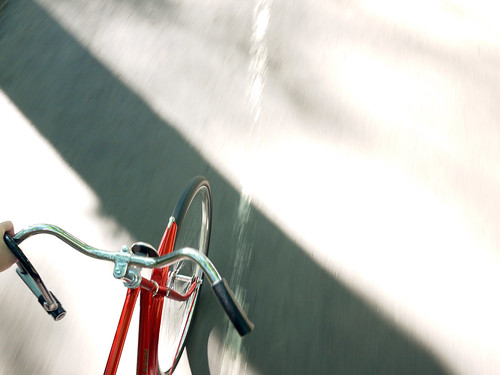
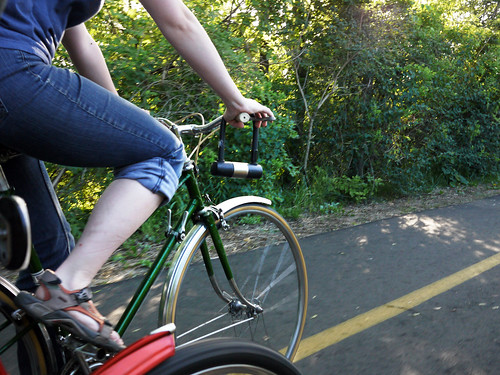
Luckily, the Rivertrail is in great shape right now, clear of flooding and well-maintained. We cruised along on our old Raleigh bikes, enjoying a leisurely sweatless ride in the humid heat.

Big Lug

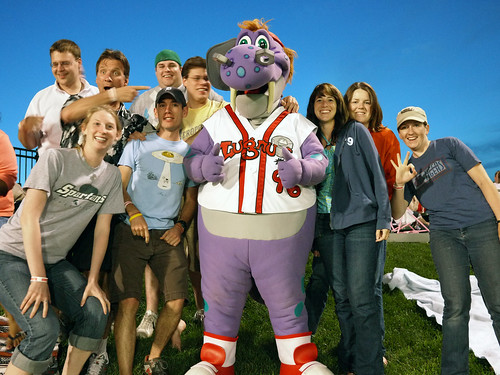
It cooled off a bit as the sun went down and the Lugnuts battled to a loss extra innings. Still, it was another perfect Thirsty Thursday out in left field, and a great day to be in Lansing.

Lugnuts

Tuesday, June 8, 2010

The case for wider tires

More than any other component, a tire change can radically change the ride of a bicycle. A good road tire can make a bike feel lively, smooth out road vibrations, and speed up the rider, all at the same time. In contrast with the usual skinny high-pressure tires that come standard on road bikes, my experience tells me wide tires with fine tread and light casing have the best combination of speed, smoothness, and roadfeel.

Rawland Sogn: Street

Today, most manufacturers design modern road bikes so they do not accept a tire wider than 700x25c, with tight brake and seatstay clearance that also precludes fender mounting. This is fine for a race bike (though I'd argue room for 28mm tires would be beneficial there too), but a 23mm wide tire is really not ideal for commuting or multi-day rides. Those shopping for a road bike with this in mind would do well to check out brands like Surly, who make steel frames with clearance for wider tires, and cyclocross bikes, which are designed to fit up to 700x35c tires and typically have cantilever brakes. Many older steel bikes did have more clearance for wide tires and fenders, and if you feel like it, a tight frame can get more clearance when converted to the 650b wheel size, which you can read about here.

650b Trek 560

Even experienced cyclists will repeat the fallacy that skinny tires are faster than wide tires, but tests at Bicycle Quarterly have shown that on imperfect surfaces like, say, Lansing's roads, a well-made ~30mm tire is actually fastest. The reason for this is that the cyclist loses a fair amount of speed to the road vibration that occurs with these narrower tires. Above 30mm, tires typically cannot hold the high pressures that fast road riding requires and tires get heavier, and so speed again starts to fall off, but with an increase in plushness.

Grand Bois Cypres

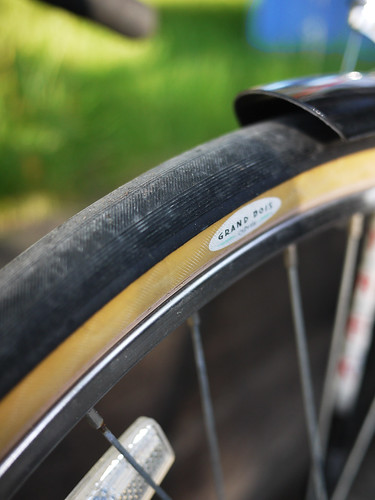
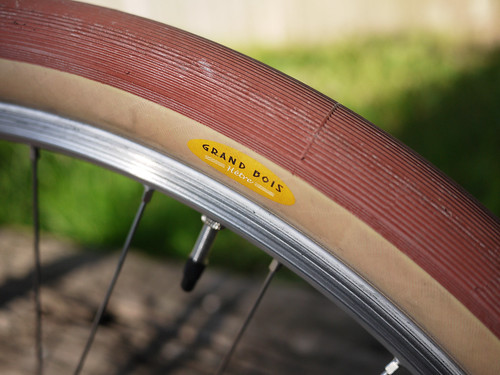
A high-quality tire at this width can ride like a dream, and some of the best come from Japan's Grand Bois. They specialize in the 650b wheel diameter, which falls about halfway between 26" and 700c wheels, which no major manufacturer that I can think of supports, but there has been a recent resurgence of interest in thanks in part to companies like Rivendell, Grand Bois, and many custom framebuilders. My wife has been riding on a 650b-converted Trek 560 shod with Grand Bois Cypres 30mm tires for a couple years now, and has nothing but positive things to say about them, and these tires are also available in a more conventional 700cx30 size. The 42mm wide Grand Bois Hetre tires have also proven to be a good combination of speed, comfort, and feel. My friends kid me that I'm riding my beach cruiser when I put the Hetres on my Rawland Sogn, but the tires feel and ride great, plain and simple.

Grand Bois Hetre

High-end tires like those made by Grand Bois and Challenge are not cheap, running at times well above $100 for a pair, and while folks have shown they are willing to shell out big bucks for a wheelset, pedals, and the like, tires are often a component that people feel they can spend less on. Panaracer's Pasela and Schwalbe's Marathon tires are some of the more moderately priced entries on the market and are available in a wide variety of sizes. These tires come in kevlar-belted varieties for puncture-protection, but in my experience these Kevlar belts actually produce a stiffer ride, and do not provide enough puncture protection to make the trade-off worthwhile.

Thursday, May 27, 2010

Depth of Field: Don't Overdo It!

Dusk: Summer Picnic Winding Down
Taken with my Polaroid 110a at f/4.7

For good or bad, shallow depth of field is the attribute of a photograph that typically strikes a viewer as a quality of professional photography. It is also the subject I'm asked most about by lay photographers. I have seen many uses of shallow depth of field when it's inappropriate, and many budding photographers overuse the hell out of it once they figure out what it is, and how to produce it.

First, "depth of field" is a measure of how much of a photograph is in focus from near to far. Shallow depth of field is produced when the focus point is in focus, and that's about it, while deep depth is produced when essentially everything is in focus. It can be affected by many different things: lens aperture, lens focal length, isolation of subject from background, focal distance, and negative or sensor size.

Essentially, depth of field is at its shallowest when the subject is nearer to the camera, the aperture is set wider than say f/2.8, the lens is about 85e or longer, and the camera has a large negative size. Of these factors, one that seems to play a huge role is sensor or negative size; a large negative will always carry a shallower depth of field. This is why you can't get that background to go out of focus on your point and shoot digital camera, even with a wide open aperture. Really, if you want shallow depth of field, the simplest way to get it is to pick up a cheap 1970s mechanical film SLR with a 50mm f/1.8 lens, and go to town.


Sensor/negative size comparison chart

Aperture is important, sure, but a large negative size will prevail over a narrow aperture in many situations. My Polaroid SX-70 has an effective negative size of 3x3 inches, putting it squarely in medium format territory. Its maximum aperture is only f/8.8, but even as such it has a nice shallow depth of field in many situations:


As I mentioned earlier, shallow depth of field is easy to abuse once you know how to use it. If you want to isolate a subject from a background, it's wonderful; if you would like to take a photo of an object receding into the distance, not so much usually. It's also easy to overdo it at a certain point, where your subject is not necessarily entirely in focus, which can become distracting. You can also miss out on a lot of interesting background images if you become too obsessed with shallow depth of field. Finally, I tend to notice that modern lenses, with their ultra-sharp plane of focus, can produce rather ugly effects as focus falls off and the background becomes blurred.

Here are some of my favorites from others and myself:

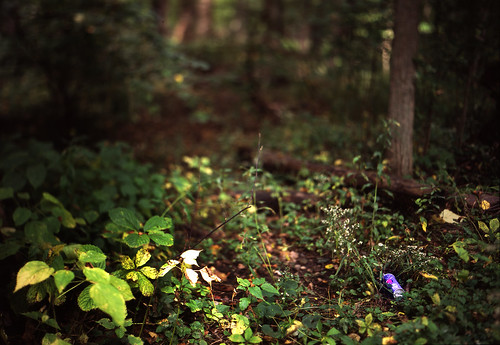
Underbrush
(Mine - Tilted film plane adds makes the depth even shallower )


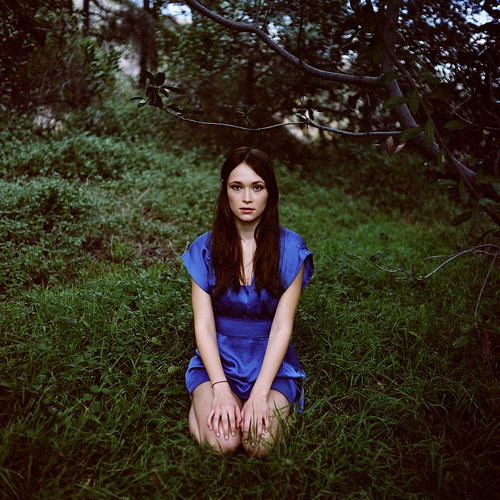
One of Lou O'Bedlam's many awesome portraits.


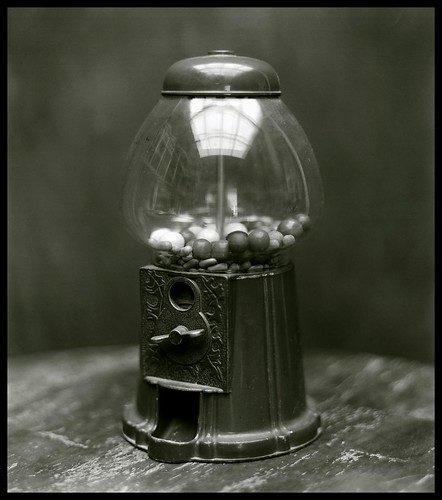
Some of my friend Andy's amazing work with the old Kodak Aero-Ektar lens.

Finally, though I don't show his work in this post, I also highly recommend checking out the photos of Jonathan Hillhouse. His depth of field usage is often incredible.

Sunday, May 23, 2010

Ride of Silence

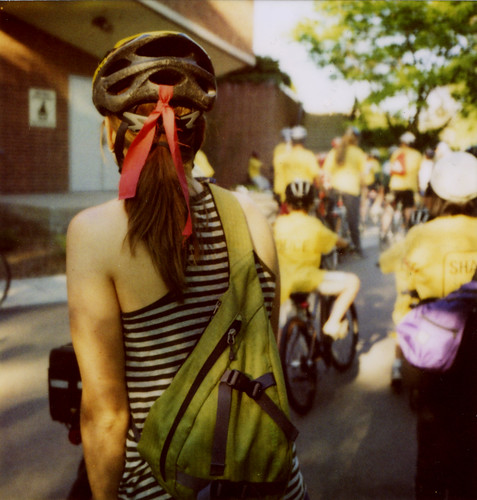
This past Wednesday was the annual Ride of Silence in North America. If you're not familiar, the Ride of Silence is a slow group ride to remember those cyclists who have been injured or killed while cycling on public roadways. If you are interested in finding a ride near you for next year, check out this link.

I took along my Polaroid SX-70 and took some of the last 600 film I have access to.


Ride of Silence 2010

Tuesday, May 4, 2010

Happy Polaroid Week!

An indelible mark

This Monday through Friday mark the spring Polaroid week on Flickr, where instant photographers post lots of incredible photos to a group pool to show how distinct and versatile that medium is. People always ask me, "What kind of camera is your favorite?" and my answer always has to be Polaroid, strange as that may seem. There are many reasons for this - my first real camera was a Polaroid SX-70, inherited from my grandfather. Also, I have many fond memories of Polaroids from my youth, when we would go fishing, or at a birthday party. When I got into film photography again, the Polaroid was there for me - easy to scan, instant results, and incredible colors.

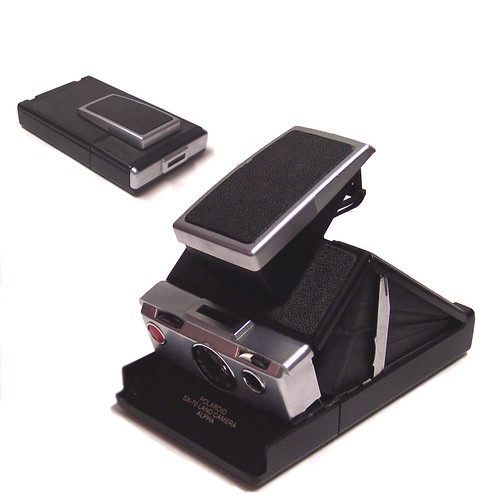
Polaroid SX-70

But more than that, Polaroid made some very interesting film and cameras. The SX-70 is in my opinion the greatest camera ever made. It's an SLR that folds completely flat and is easy to carry, has a great lens that focuses down to 10 inches, and for the first time a camera developed prints before your very eyes, in daylight no less. It has the ability to amaze everyone from children to ol pro photographers. The film has that unique Polaroid look to it, with faded colors, development abnormalities, and an overall glow. There are photoshop actions that mimic it, but nothing ever gets it quite right.

Lot 87

So whenever Polaroid week comes around, it reminds me to shoot up the remaining film stock that I have, and to enjoy those cameras once more. The film I love is gone for good - Polaroid quite making Time-Zero, 600, 669 and all the rest a couple years ago. Thankfully I can stock up on the equivalent Fuji films for my old packfilm warhorse, and for the SX-70, the Impossible Project is doing some remarkable work bringing new filmstocks to the market. I personally can't wait to try their black and white 600 version of the new Silver Shade films. \

Here are some of my favorite Lansing-themed Polaroids:

Breakfast better than Sex
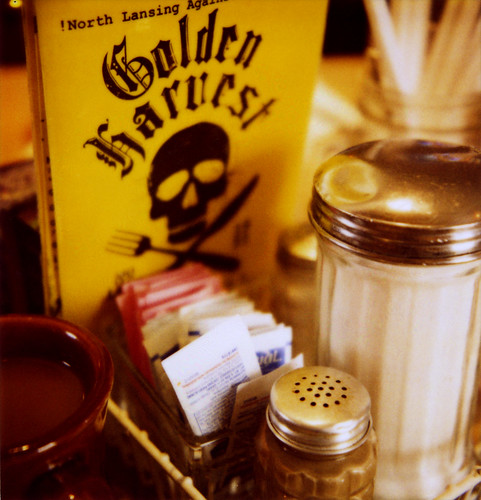
Golden Harvest

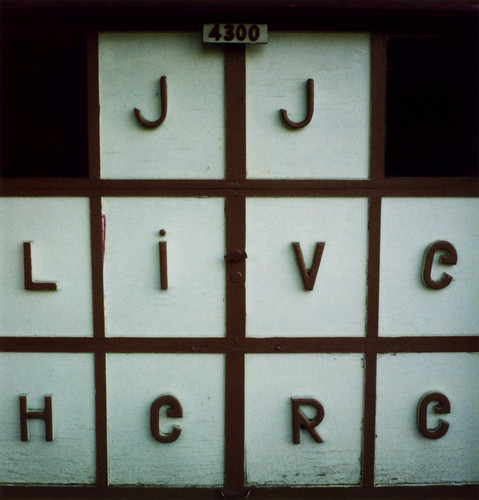
JJ  Live HeRe
JJ Live Here

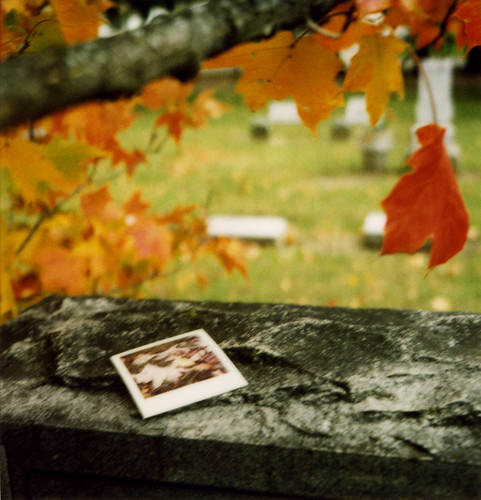
Gift on an Autumn Grave
Mt Hope Cemetery

Monday, April 26, 2010

Lansing Tweed Ride


Get down with your dapper self and join us for a Trajet de Tweed around Lansing on Saturday May 1st at noon, departing from Lansing's Frandor Shopping center, specifically the skate park area. It'll be a short leisurely ride about town, with the option of further riding with the Healthy Lungs Ride at 1:30 pm to celebrate the smoke-free bar legislation, or just partake in some refreshing ale at a nearby pub. Contact Marci Baranski for more details.


On an unrelated note, one of my friends was recently hit by a vehicle while riding his bike on campus. I don't know all the details yet, nor do I know if I should share them, but if you're driving around the area please be careful - there are beginning to be lots of bicyclists on the streets.